Series 2, June 9, 2026
Cloud IAM
2 minute read, by Becky Sandberg
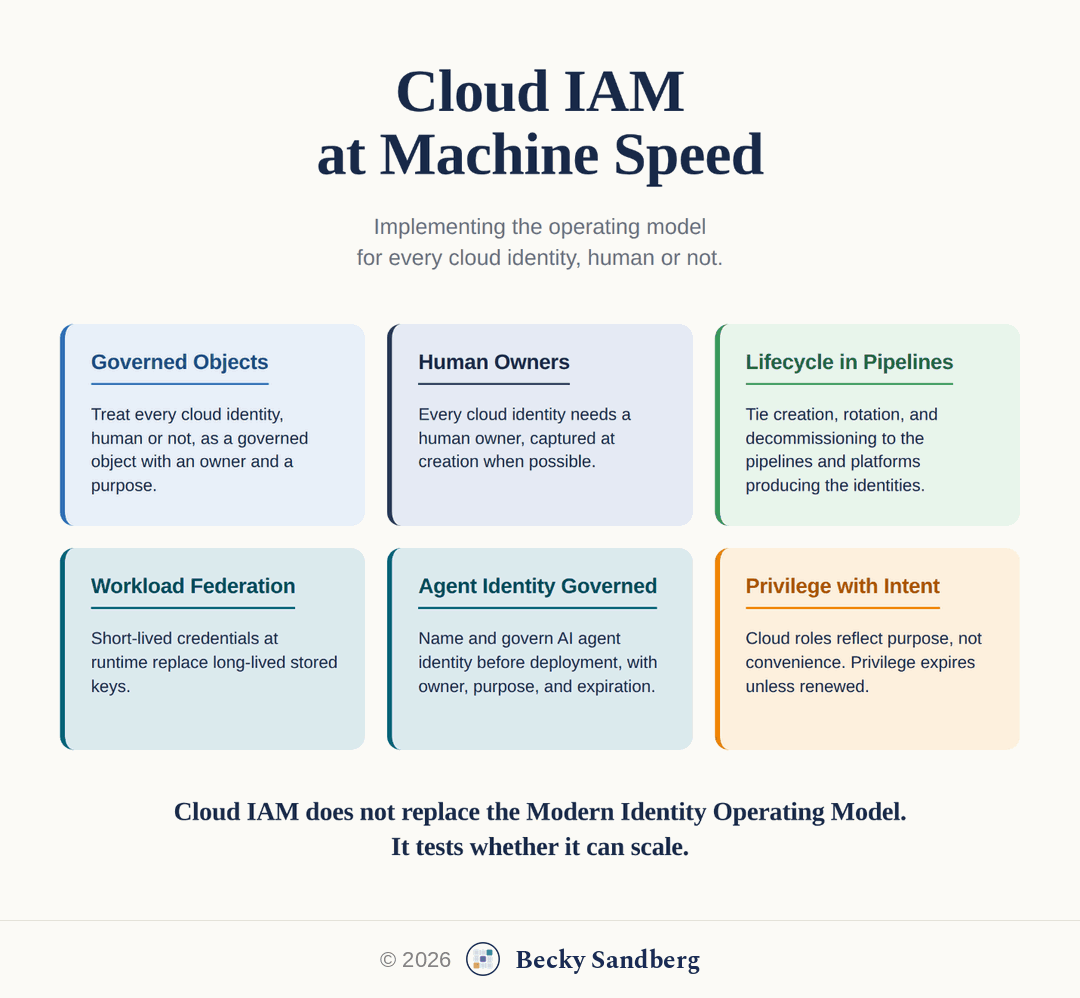
Cloud IAM is not a separate operating model. It is the same model running at machine speed, across platforms, with credentials that should expire before anyone remembers to rotate them.
When I partnered with cloud security teams in past environments, the pattern was familiar. Machine identities outnumbered human ones by significant ratios. Long-lived keys sat in code, vaults, and config files. Service principals created years ago still held privilege no one could explain. AI agents now add another order of magnitude to that surface.
The principles are not new. The cadence is.
Implementing cloud IAM as a function of the operating model means treating every cloud identity, human or not, as a governed object with an owner and a purpose. It means lifecycle discipline tied to the pipelines and platforms producing the identities. It means AI agent identity is named and governed before agents deploy, with owner, purpose, and expiration captured at creation. It means workload identity federation, where the platform issues short-lived credentials at runtime instead of stored keys, replaces long-lived secrets wherever it can. It means cloud roles reflect purpose, not convenience, and privilege expires unless renewed with intent.
Cloud discovery is continuous. Platforms generate identities faster than people can document them, and every one needs a human owner. Where the platform supports it, ownership is captured at creation. Where it does not, ownership has to follow quickly, before the identity becomes another orphan.
Sequence matters. Existing long-lived credentials need a retirement plan, not just a rotation calendar. New workloads need workload identity federation from day one. AI agents need governed identity before deployment, so they do not end up acting under shared human credentials.
Start by getting clear on:
- Which cloud identities have no defined owner
- Where long-lived keys and secrets still exist
- Which workload and AI agent identities are overprivileged
- Where role design favors convenience over purpose
- Which platforms generate identities faster than governance can absorb
Measure:
- Cloud identities with defined owners, by identity type
- Long-lived keys or secrets still in use
- Workload identity federation coverage
- Privileged cloud roles without clear business purpose
- Unused or dormant workload and agent identities
Cloud IAM does not replace the Modern Identity Operating Model. It tests whether it can scale.
❓ Where is your biggest cloud identity gap: ownership, privilege design, or credential discipline?
Put it to work. The free toolkit turns ideas like this into templates, a five-minute assessment, and a first move you can finish.
Open the free toolkit