Series 2, July 17, 2026
Conclusion
2 minute read, by Becky Sandberg
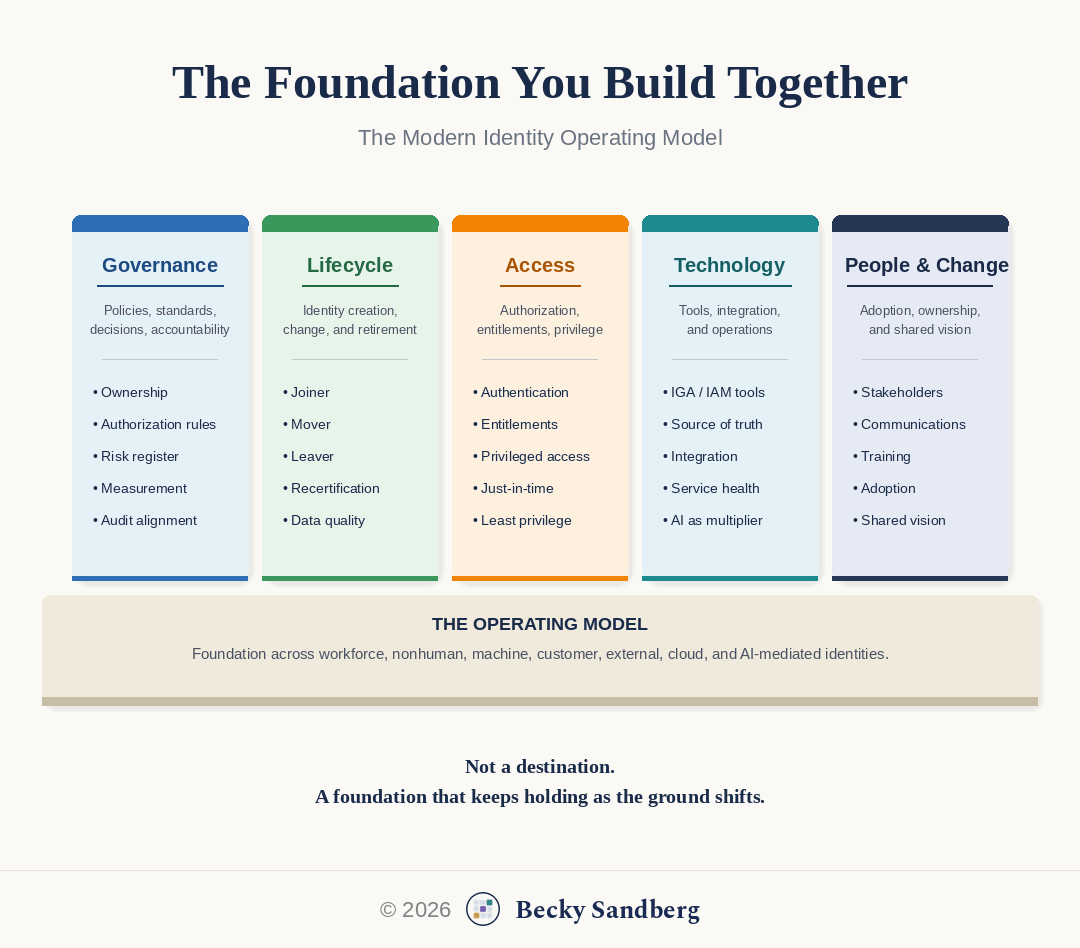
Conclusion: The Foundation You Build Together
Series 1 was the model. Series 2 was implementation. This is the close.
I once watched an identity director explain the operating model to a room of leaders who had only seen identity through capability lists and tool inventories. Within an hour the conversation changed. Not because the framework was novel, but because it gave language to what they had been wrestling with for years. They could see the whole. They could name what was missing. They could decide what to build.
That is what the operating model does when understood as a foundation, not a framework. It gives a leader something to teach. A team something to build. An organization something to commit to.
Across this series, the same pattern kept showing up.
Identity weakens where:
- Ownership is unclear
- Source of truth is weak
- Lifecycle is incomplete
- Authorization is governed in the wrong place
- Privilege is convenient, not intentional
- Exceptions become design
- Drift becomes normal
- Operations are unowned
None of these are isolated failures. They are operating-model conditions. They show up across workforce, nonhuman, machine, customer, external, cloud, and AI-mediated identities. The model lets you see them as one system instead of nine.
That is the foundation.
Knowing the whole helps you build the parts. Teaching the whole helps the organization decide what to build next. Shared vision becomes possible because there is something to share.
The work is not finished when the implementation is.
The model has to keep holding as identity expands into territory still taking shape. AI agents outnumbering humans. Conversational interfaces. Identities that act in milliseconds. Arriving while the foundation is still being built. Series 3 will look ahead to what identity must become.
That is why the model matters. A foundation that holds only in stable conditions is not a foundation. It is a diagram.
There is no shortage of identity content in 2026. Capabilities lists. Control planes. Trust diagrams. All real. All matter. But capabilities only hold when there is something underneath. The work that endures is the foundation the organization can rely on, across leaders, teams, and tools.
This series is the structural framing. The book taking shape alongside it is the deeper work.
The operating model is not a destination. It is the foundation you build together, then keep teaching as the ground shifts.
❓ What part of your operating model are you still helping your organization understand?
Put it to work. The free toolkit turns ideas like this into templates, a five-minute assessment, and a first move you can finish.
Open the free toolkit