Series 2, June 2, 2026
External Identity Governance
2 minute read, by Becky Sandberg
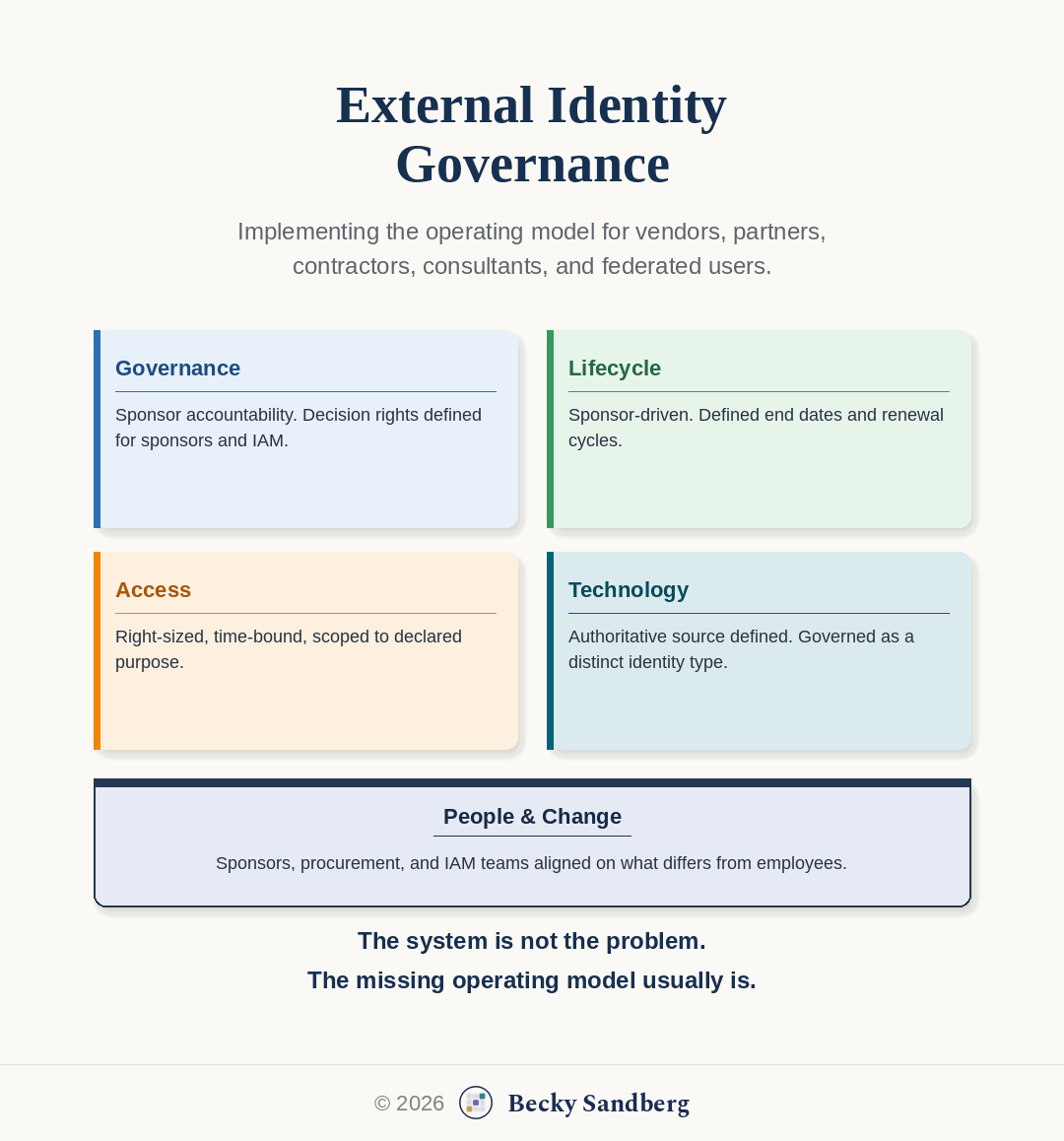
External identity governance starts where the source of truth lives. And the source of truth is rarely in one place.
In most enterprises, external identities outnumber employees, touch the same data, and have less governance behind them. More than one third of breaches now start outside the organization. External identity is where the operating model goes quiet, and where most identity programs lose.
Some of the most infamous breaches in the last decade started with an external identity. A vendor with too much access. A contractor account that lingered after the contract ended. The pattern is consistent enough that it is not a coincidence. External identity is the soft edge of most identity programs, and attackers find it.
Contractors are sponsored by managers and tracked by HR or procurement depending on the organization, and the teams given that responsibility often feel stuck. Vendors are procured by sponsors and app owners but land in IAM later, often without context. Partners are agreed at the leadership level but federated by security. Managed service providers often have privileged access with little visibility into what they are doing day to day.
And some external identities never enter through any formal path. They are created the moment someone shares a file or invites a guest to a channel. IAM may not know they exist.
The identity is created. Someone walks away from the lifecycle. The owner is unclear. The end date is informal. The access is overbroad. Six months later, it is a permanent exception.
External identities follow the same operating model as every other identity type. The principles do not change. The patterns inside them do.
Sponsor accountability is the foundation. Lifecycle is sponsor-driven, with defined end dates and renewal cycles. Access is right-sized and time-bound. The authoritative source is defined and trusted, whether that lives in HR, a vendor system, or somewhere else. Sponsors, procurement, and IAM teams stay aligned on what differs from employees, or the model breaks down at the seams.
Start by getting clear on:
Who sponsors each external identity and what decisions they own
How each external type enters and exits the environment
Where access is broader than the sponsor's stated purpose
Measure:
- External identities with defined sponsors
- Accounts with end dates or renewal cycles
- Time to remove access when external work ends
The system is not the problem. The missing operating model usually is.
❓ Which external identity type is hardest to govern in your environment today?
Put it to work. The free toolkit turns ideas like this into templates, a five-minute assessment, and a first move you can finish.
Open the free toolkit