Series 2, May 26, 2026
Nonhuman and Machine Identity
1 minute read, by Becky Sandberg
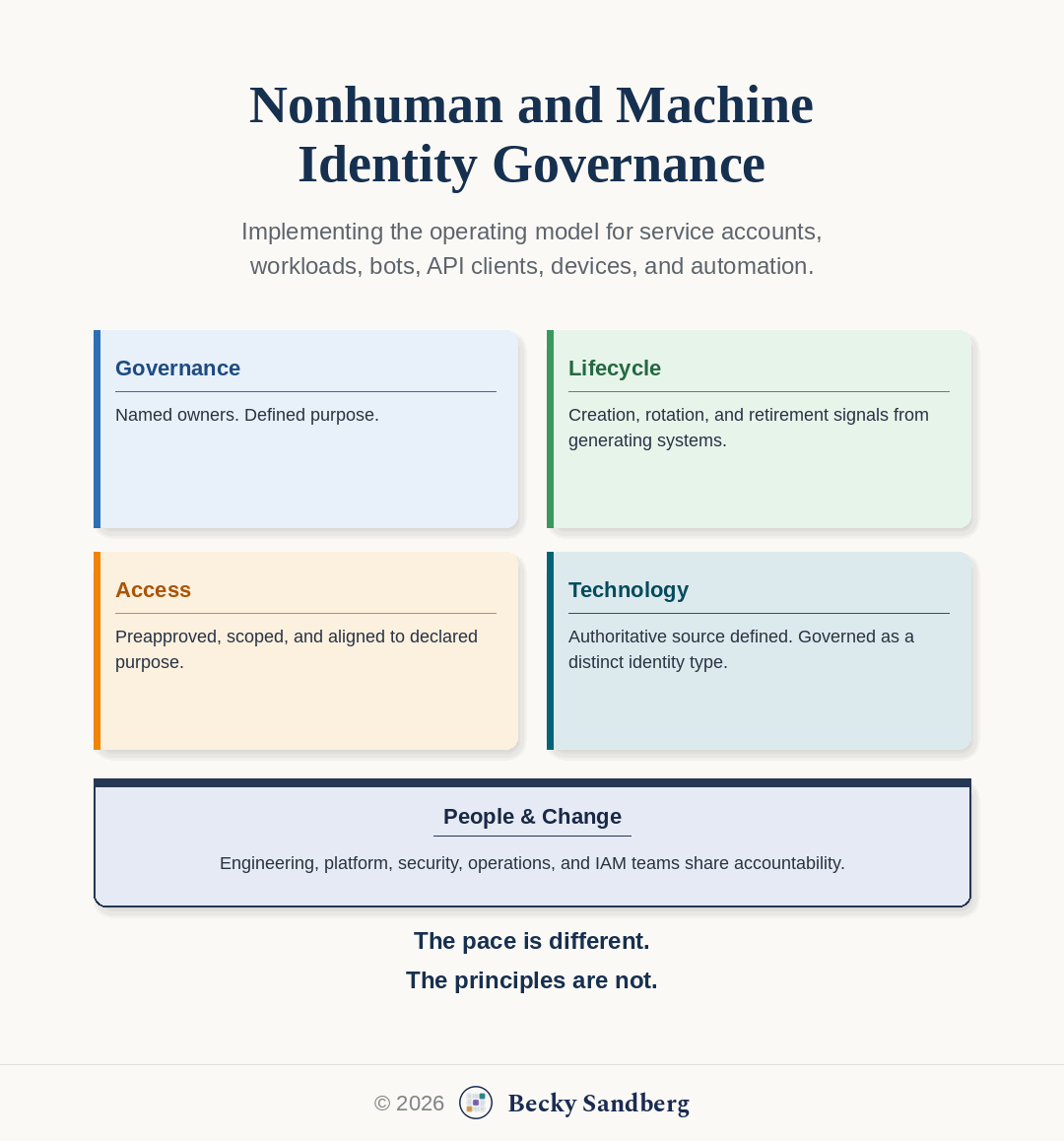
Nonhuman identities now outnumber human ones in many environments. Service accounts, workload identities, API clients, automation identities, and AI agents authenticate and act across systems every day.
The operating model still applies. The principles do not change. The patterns inside them do.
Most nonhuman identity gaps come from assuming employee patterns work here. They do not. Some nonhuman identities were created years ago with no owner. Others are created automatically by pipelines, platforms, and integrations. The model has to account for both.
Every nonhuman identity needs a named owner and a defined purpose.
Lifecycle signals come from the systems that generate them, not from tickets or tribal knowledge. Access is preapproved, scoped, and aligned to declared purpose. Cloud platforms, secret stores, and orchestration tools provide authoritative signals. Engineering, platform, security, operations, and IAM teams share accountability for what they create.
AI agents follow the same authentication and authorization patterns. They just move faster, which means the model has to be clearer.
Start by getting clear on:
- Who owns each nonhuman identity and why it exists
- How creation, rotation, and decommissioning signals flow
- Where access is broader than the declared purpose
- Which platforms and pipelines create identities outside governance
- How engineering and identity teams share accountability
Measure:
- Nonhuman identities with named owners and defined purpose
- Automated rotation and decommissioning coverage
- Access alignment to declared purpose
- Time to detect and remove unowned or stale identities
- Cross-team accountability for identity creation
Nonhuman identities need the same clarity, accountability, and discipline as every other identity type.
The pace is different. The principles are not.
❓ What part of nonhuman identity governance is hardest to make real in your environment today?
Put it to work. The free toolkit turns ideas like this into templates, a five-minute assessment, and a first move you can finish.
Open the free toolkit