Series 2, June 16, 2026
Privilege
2 minute read, by Becky Sandberg
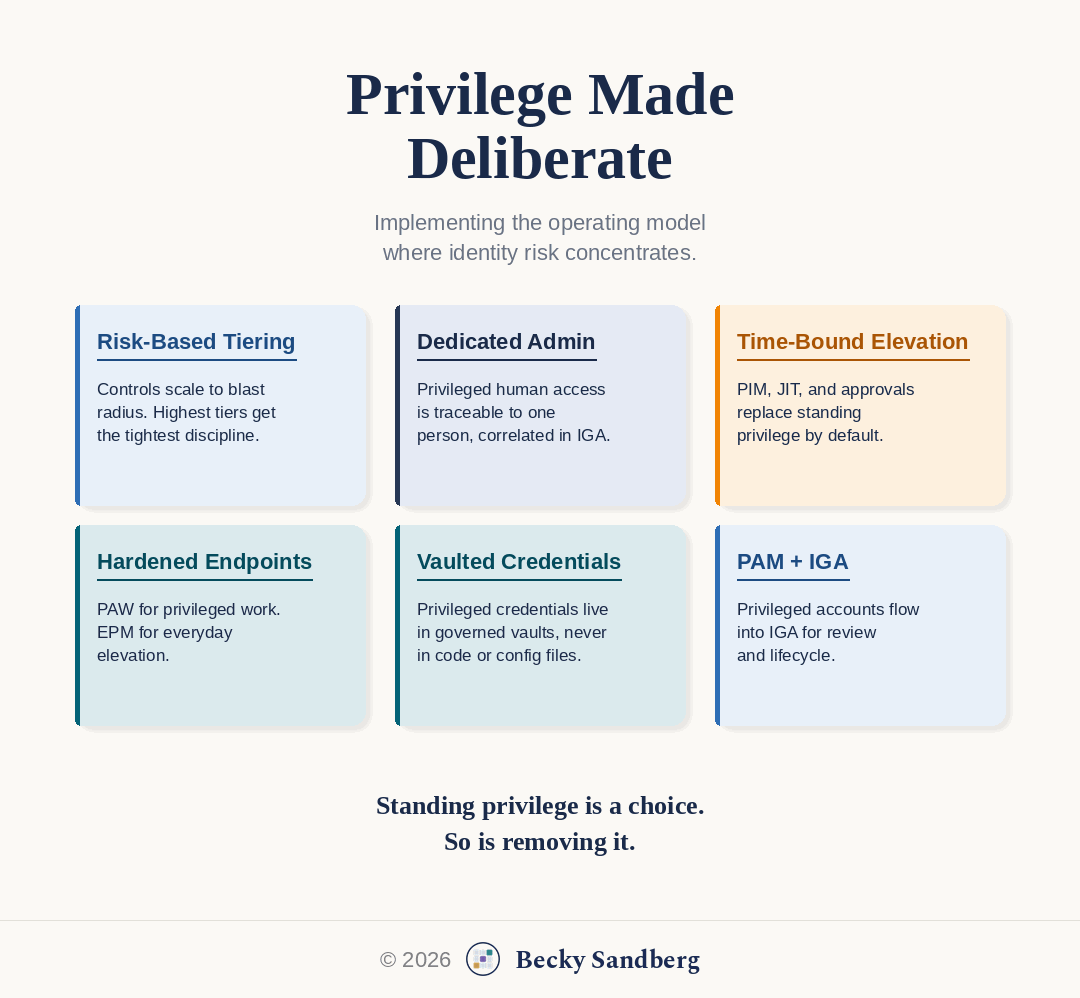
Privileged Access Management (PAM) is a specialized discipline within IAM. The operating model has to make privilege deliberate because the blast radius requires it.
The same patterns persist: standing admin rights, shared privileged accounts, emergency access never tested, privileged service accounts no one owns. Privilege is where identity risk concentrates, and implementation extends that discipline across every identity type holding elevated rights.
Implementing privilege as a function of the operating model begins with least privilege: access only when needed, scoped, and time-bound. It means privileged access used by humans is attributable to one person, delivered through dedicated admin accounts where the platform supports separation, correlated to the human in IGA, and vaulted for the highest tiers. It means privilege is not assigned to standard accounts as a rule, with documented exceptions where applications cannot support it. It means privilege is tiered by risk: the highest tier requires dedicated admin accounts and explicit approval, while lower tiers may use role activation with strong audit. And it means PAM and IGA work together, so privileged reviews run through the same certification cycle as standard access.
For nonhuman privilege, the mechanics differ but the discipline holds. Privileged credentials live in governed vaults, not in workforce password tools, code, or config files. Privileged nonhuman, cloud, and AI agent identities are governed at creation with owner, purpose, and expiration captured.
Sequence matters. Existing standing privilege needs a retirement plan. New privileged access uses time-bound elevation from day one. Privileged nonhuman and agent identities need governed creation, not cleanup.
Start by getting clear on:
How privilege is defined and tiered by risk across systems
Which humans hold privilege on standard versus dedicated admin accounts
Which credential vaults and password managers exist, and what each holds
How break-glass access is governed, tested, and monitored
Which privileged nonhuman and agent identities have no owner
Measure:
- Identities with standing privilege, by tier
- Privilege on standard versus dedicated admin accounts
- Privileged credentials outside governed vaults
- Privileged nonhuman and agent identities without owners
- Privileged review coverage tied to risk tier
Privilege does not become safer because it is documented. It becomes safer when the operating model makes it deliberate.
❓ Where is privilege still implemented for ease of use instead of security?
Put it to work. The free toolkit turns ideas like this into templates, a five-minute assessment, and a first move you can finish.
Open the free toolkit