Series 2, June 26, 2026
Workflow Integrity
2 minute read, by Becky Sandberg
A workflow can succeed technically and still fail operationally. The form works. The approvals route. The connector runs. But the outcome is still wrong.
That happens when the workflow is carrying weak assumptions about ownership, entitlement purpose, or what the request is actually supposed to achieve. The technology executes. The model underneath it does not hold.
People feel it when:
They cannot tell what to request
Approvers do not understand what they are approving
Requests route to the wrong owner
Provisioning completes but the access is wrong
Manual correction becomes part of the process
A workflow with low integrity creates rework, weak decisions, entitlement growth, and shadow processes no one meant to design.
AI is starting to reshape this layer. Intelligent request recommendations, approval recommendations based on peer behavior, workflow generation from plain language. The forward direction is real. But the integrity problem starts before AI can help. If the workflow does not know who owns what, no amount of intelligence on top of it can recover what was never there.
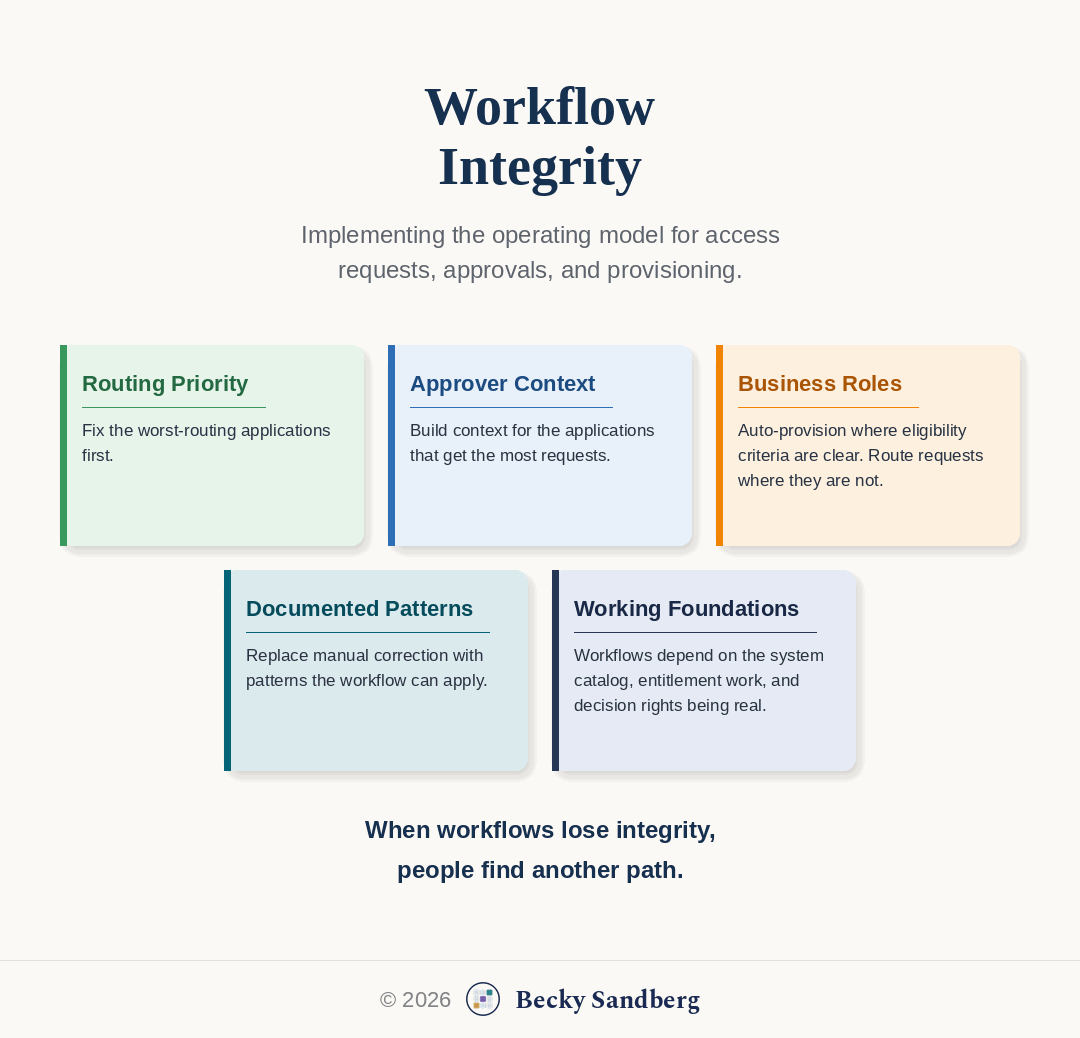
Implementing the operating model for workflow integrity does not require replacing your IGA platform or buying a new request portal. It can be built piece by piece. Fix the worst-routing applications first. Build approver context for the highest-volume requests. Build business roles for common access patterns. Auto-provision where eligibility criteria are clear. Route through request workflows where they are not. Workflows route to owners, present entitlements, and reflect decision rights. They depend on the system catalog, the entitlement work, and the decision rights matrix being real, not aspirational.
Start by getting clear on:
Whether request options are understandable to the people using them
Whether approvers have enough information to make a real decision
Whether workflows consistently route to the right owner
Where provisioning succeeds technically but fails operationally
Measure:
- Requests requiring manual correction
- Approvals returned or rerouted
- Provisioning failures by root cause
- Access requests completed outside standard workflow
When request workflows lose integrity, people find another path. They always do.
❓ Where do your workflows lose integrity most often: request design, approvals, provisioning, or correction after the fact?
Put it to work. The free toolkit turns ideas like this into templates, a five-minute assessment, and a first move you can finish.
Open the free toolkit