Series 2, May 29, 2026
AI Agent Identity Governance
1 minute read, by Becky Sandberg
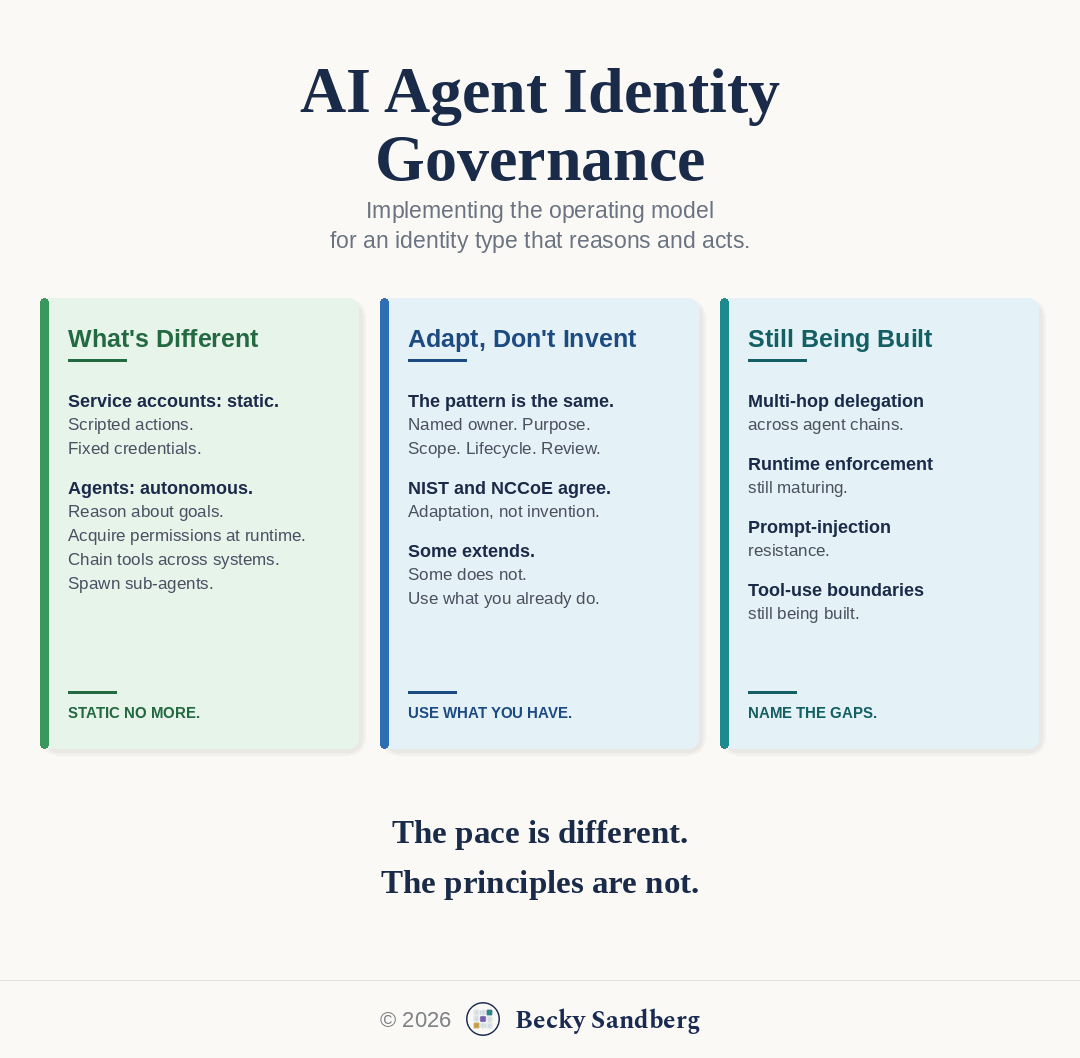
AI agents sit inside the nonhuman identity category. The implementation patterns do not.
I have watched identity programs try to absorb agents the way they absorbed service accounts. It does not work. Service accounts are static. Agents reason about how to accomplish goals, acquire permissions at runtime, chain tools across systems, and produce action sequences their creators did not anticipate.
The implementation direction is becoming clearer. In its February 2026 concept paper on software and AI agent identity and authorization, NIST and NCCoE take a clear position: adaptation, not invention. Extend existing standards thoughtfully.
That aligns with how the operating model treats every identity type. Agents need the same things the model already names. A named owner. A declared purpose. A scope of allowed actions. A lifecycle including creation, modification, and decommissioning. Review and accountability inside the same governance structure.
Some of this can be extended from what identity teams already do.
Some cannot. Access delegation across multi-hop agent chains remains an open problem.
Runtime enforcement is still maturing. Prompt-injection resistance and tool-use boundaries are still being built. Be honest about what is solved and what is not.
The work is extending what the operating model already does to a new identity type. Same governance. Same lifecycle. Same review. Applied at a pace the model was not designed for.
Start by getting clear on:
• Which agents exist and who owns them
• Whether each agent has a declared purpose
• Whether agents are governed in lifecycle and review
• Where agents run under shared or human credentials
• Which agent capabilities exceed declared purpose
Measure:
- Agents with named owners and declared purpose
- Agents governed in lifecycle and review
- Agents under shared or human credentials
- Privileged agents without owners or expiration
- Agent activity outside declared purpose
Agent governance is not a separate operating model. It is the same model applied to a faster, less predictable pattern.
The pace is different. The principles are not.
❓ Is AI agent governance in your environment mainly an adoption gap, a capability gap, or a governance gap?
Put it to work. The free toolkit turns ideas like this into templates, a five-minute assessment, and a first move you can finish.
Open the free toolkit