Series 2, June 5, 2026
Customer Identity
2 minute read, by Becky Sandberg
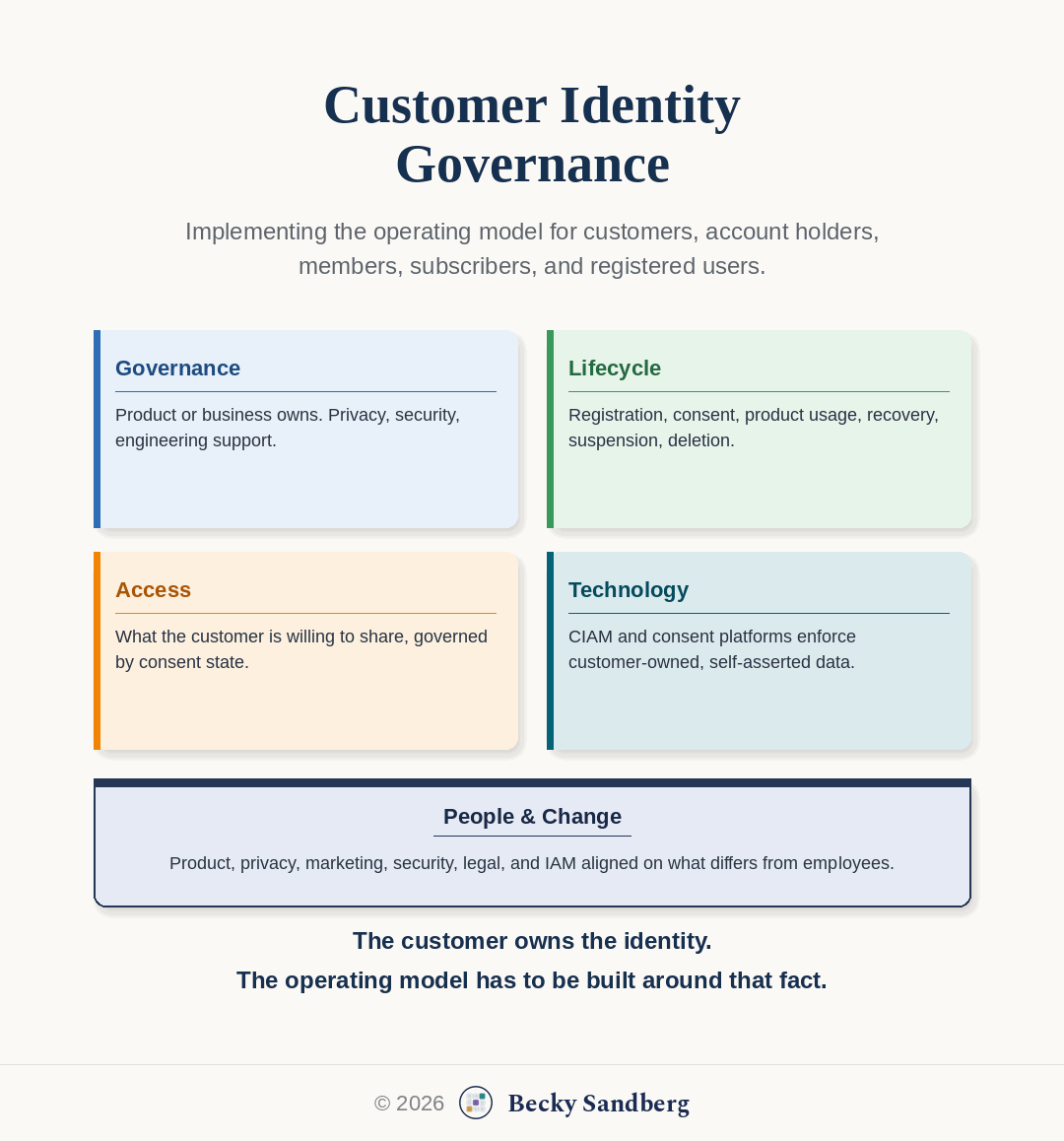
In every other identity domain, the organization owns the identity. With customer identity, the customer does.
That changes how the operating model applies. The source of truth lives with the customer. Consent is the ownership signal. Lifecycle follows product usage, not employment events. The organization holds the identity under obligation, not under default control.
Privacy and consent regulations have been multiplying for years. The bar keeps rising. A CIAM platform that cannot demonstrate auditable consent for every data processing purpose is no longer a gap. It is a compliance liability.
Customer identity follows the same operating model as every other identity type. The principles do not change. The patterns inside them do.
Product or business service owns customer identity, with privacy, security, and engineering supporting. Lifecycle is shaped by registration, consent, product usage, account recovery, suspension, and deletion. Access is what the customer is willing to share, governed by consent state. The authoritative source is the customer's own data and self-asserted attributes, enforced through CIAM and consent platforms. All of these owners stay aligned on what differs from employees, or the model breaks down at the customer's first bad experience.
Most product and business teams do not realize they are inside the identity operating model. They think of themselves as building customer experiences. The first implementation move is bringing them into the conversation. Get product, privacy, security, legal, and IAM together and build a shared understanding of who decides what. Call it a decision matrix, a RACI, or whatever artifact your organization uses. Consent design. Account recovery boundaries. Deletion SLAs. Cross-brand data flow. Once those decisions have owners, the rest of the model has something to encode.
Start by getting clear on:
Who owns customer identity decisions across product, privacy, security, and legal
How consent is captured, stored, honored, and synced across brands
How account recovery and deletion meet regulatory expectations
Measure:
- Whether ownership for customer identity is defined and adopted
- Whether consent state is enforced consistently downstream
- Whether account recovery and deletion meet regulatory SLAs
When customer identity is predictable, customers feel trust. When it is inconsistent, regulators notice.
The customer owns the identity. The operating model has to be built around that fact.
❓ What is the hardest part of customer identity governance to define in your organization today?
Put it to work. The free toolkit turns ideas like this into templates, a five-minute assessment, and a first move you can finish.
Open the free toolkit