Series 2, June 12, 2026
Entitlements
2 minute read, by Becky Sandberg
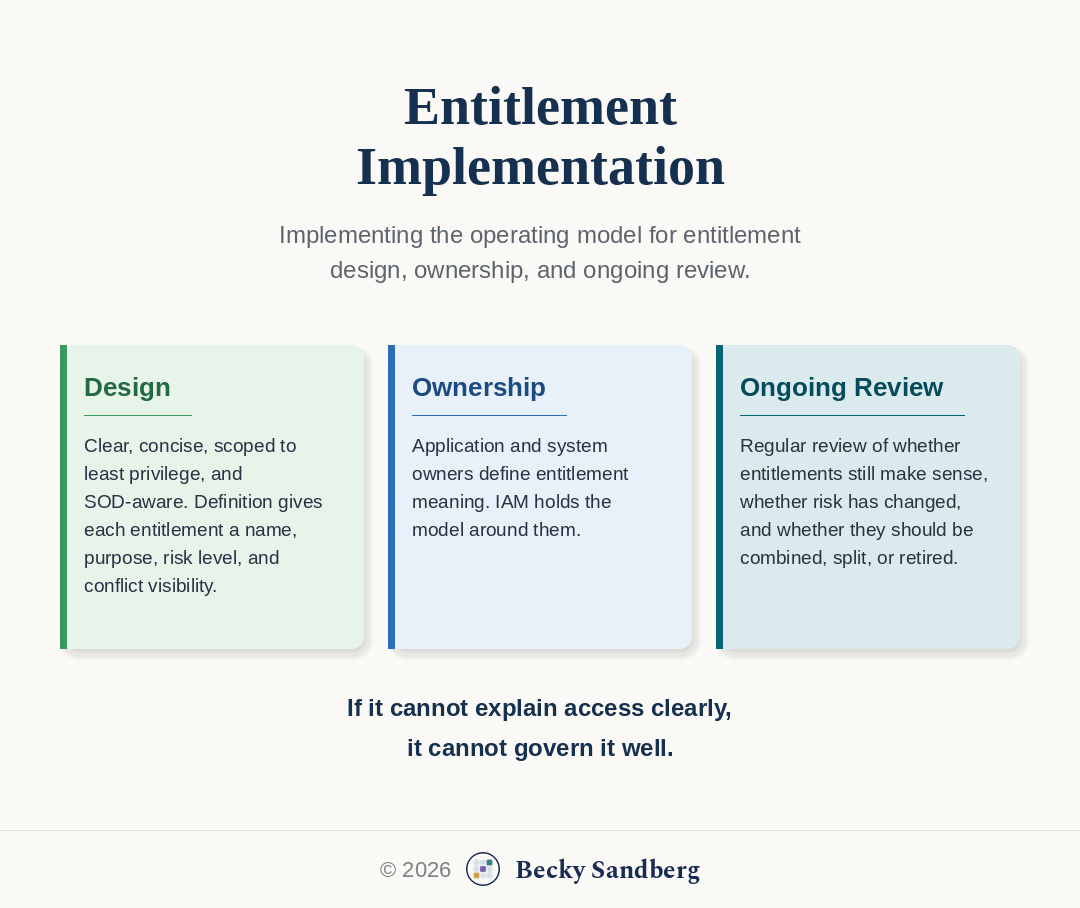
Entitlement implementation is design, ownership, and ongoing review. Without all three, what you have is not an operating model. It is a backlog.
Most entitlements were never designed. They accumulated. A role got added during a project. A group got created for one person and outlived the reason. A permission got granted because nobody had time to figure out the right one. None of this is unusual. It is how entitlements grow when no one is implementing structure.
The discipline applies across identity types. Entitlements for employees, contractors, service accounts, and AI agents all need the same thing.
Design means entitlements that are clear, concise, scoped to least privilege, and aware of segregation of duties. Definition is how that design gets captured: a name people understand, a defined business purpose, a documented risk level, and visibility into combinations that create conflict of interest.
Application and system owners are central. They know what the permissions in their systems do. IAM cannot define entitlement meaning from the outside. IAM holds the model: defining what good looks like, providing the structure for ownership, and aligning access to job function or governed criteria. The meaning of the entitlement comes from the owner.
Review is not just access certification. Entitlements themselves need regular review: whether they still make sense, whether their risk has changed, whether their purpose still applies, whether they should be combined, split, or retired. Without this, the model drifts faster than any certification can catch.
You cannot govern entitlements you cannot explain. Start with the systems where access cannot be explained today. Apply the model where it can hold first. Expand from there.
Start by getting clear on:
Which entitlements have names and descriptions that explain what they actually do
Which entitlements have named application or system owners
Which entitlements have documented business purpose and risk level
Where segregation of duties is being enforced and where it is not
Measure:
- Entitlements with documented purpose, owners, and risk classification
- Access assignments aligned to job function or governed criteria
- SOD conflicts identified and resolved
- Entitlements reviewed and updated within defined cycles
If it cannot explain access clearly, it cannot govern it well.
❓ What is the hardest part of implementing entitlement design, ownership, or review in your environment today?
Put it to work. The free toolkit turns ideas like this into templates, a five-minute assessment, and a first move you can finish.
Open the free toolkit