Series 2, May 1, 2026
How to Assess Identity Operating Model Maturity
2 minute read, by Becky Sandberg
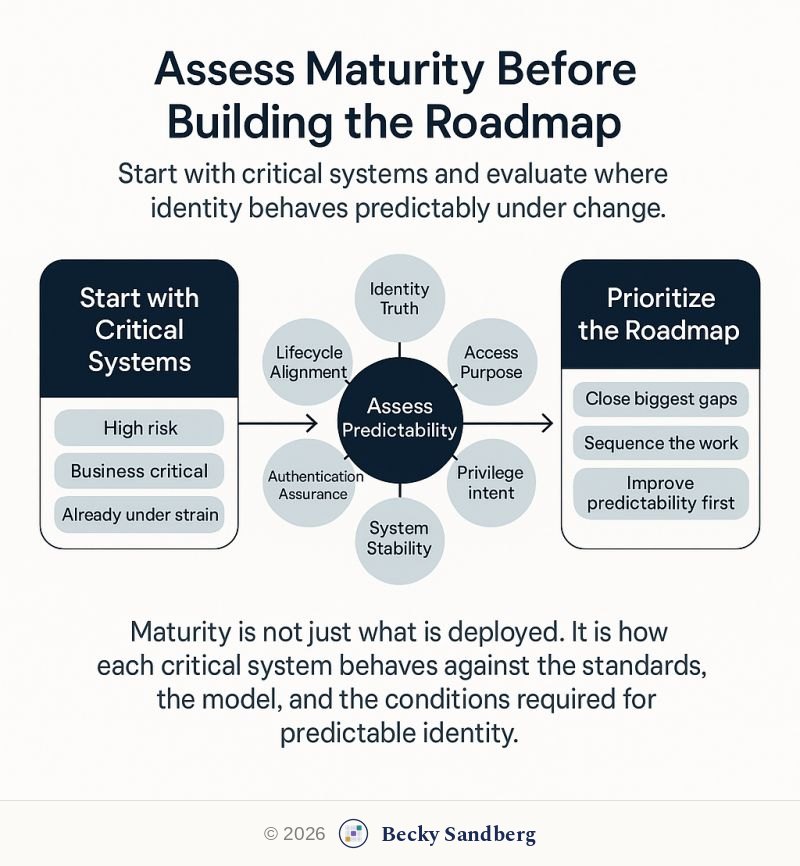
Once weak operating conditions are visible, the next step is to assess how mature the operating model actually is today.
That does not mean starting with a tool scorecard. It means assessing each critical system against the IAM standards, the intended operating model, and the operating conditions that determine whether identity behaves predictably.
A lot of identity maturity conversations still start with tooling:
what is deployed
what is integrated
what controls exist
That matters, but it still leaves out the question that matters most:
Does identity behave predictably?
In practice, maturity is less about capability count and more about how reliably the system produces the outcomes the organization expects. Mature identity environments are easier to govern because ownership is clearer, identity truth is stronger, and lifecycle, access, privilege, and authentication behave more consistently under change.
Assess maturity system by system, starting with the critical systems identified in the inventory.
For example, a critical application may already be integrated to IGA, but if its entitlements have no clear purpose, approvals route to the wrong owner, or access is still adjusted manually, the maturity gap is not the connector. It is the governance, ownership, and operating discipline around the application.
This is also a good point to talk with GRC, Internal Audit, or equivalent oversight teams to understand where concerns are already surfacing and which gaps keep showing up in reviews or audits.
Start by getting clear on:
Is ownership clear and exercised?
Does source-of-truth integrity hold across identity types?
Does lifecycle reflect organizational reality?
Do roles and entitlements have purpose?
Is authorization governed where it actually lives?
Is privilege intentional and contained?
Do authentication methods and policies reflect actual risk, identity state, and access context?
Which critical systems should be assessed first based on risk, business dependency, and current instability?
Why it matters
A predictability-based maturity view helps identify the gaps that should shape the roadmap first.
Measure:
- identity truth accuracy
- lifecycle alignment
- access purpose alignment
- privilege containment
- authentication strength
- operational reliability
- certification effectiveness
- integration stability
A mature identity operating model is one the organization can trust to behave consistently under change.
Would a predictability-based maturity model be more useful than one based mostly on tool adoption?
Put it to work. The free toolkit turns ideas like this into templates, a five-minute assessment, and a first move you can finish.
Open the free toolkit