Series 2, May 5, 2026
Identity Truth First: Source of Truth, Data, and Classification
2 minute read, by Becky Sandberg
Identity Truth First: Source of Truth, Data, and Classification
One of the key questions when building the roadmap is this:
Can the organization actually trust its identity truth?
Implementation depends on it. When systems hold different versions of the same identity and no one defined which attributes come from where, downstream decisions start losing reliability. It also gets harder when data owners do not know where their data is used downstream or what breaks when that data is wrong or late.
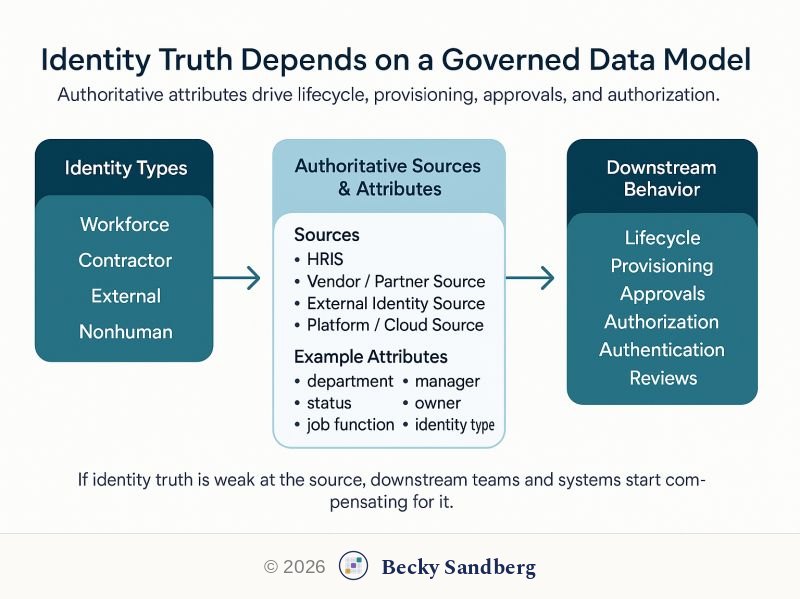
Source of truth is rarely a single system. HR may anchor workforce identity, but contractor, external, and nonhuman identities often originate elsewhere. The work is deciding which attributes are authoritative, how identity types are classified, and how updates should propagate.
Identity truth matters when authoritative source data lands where it needs to, in the form downstream systems expect. Strong data models support lifecycle, provisioning, approvals, and authorization.
This is why partner relationships matter. When source data is maintained well, downstream teams can rely on it. Improving identity truth often means helping source owners strengthen the upstream process.
Classification determines how identity is governed. If identity types are unclear, lifecycle rules, approvals, access models, and policy decisions become inconsistent.
Start by getting clear on:
Which authoritative source owns each core attribute for each identity type?
How are workforce, contractor, external, privileged, and nonhuman identities classified?
What source data lands downstream, and what does it drive?
Which attributes drive provisioning, approvals, authorization, and lifecycle behavior?
Where is downstream logic compensating for weak identity truth?
Which critical systems are showing strain from incomplete, stale, or inconsistent source data?
Why it matters
Clear identity truth improves lifecycle accuracy, access consistency, approval quality, and the predictability of downstream decisions.
Measure:
- authoritative source coverage
- identity-type source accuracy
- attribute completeness rate
- attribute freshness rate
- source-of-truth alignment rate
- conflicting attributes across systems
- manual downstream corrections tied to source data quality
Identity truth does not become reliable because a source system exists. It becomes reliable when the organization clearly defines what that source represents and how the rest of the environment should behave because of it.
Where does source-of-truth confusion create the most friction in your environment today?
Put it to work. The free toolkit turns ideas like this into templates, a five-minute assessment, and a first move you can finish.
Open the free toolkit