Series 2, July 14, 2026
Theory to Reality
2 minute read, by Becky Sandberg
This series describes how the operating model should work. The honest gap is what to do when the organization will not let it.
I once watched an operating model stall for two years. The system catalog had no clear home. Data quality was in someone else's backlog. Funding for shared tooling was waiting on a cycle. None of it was wrong. All of it was reality. The story going up was still "progress."
For the operating model to work, three things have to be true. IAM has to design it. The organization has to invest in it. Collaborating teams have to deliver against it. When any of the three is missing, the model becomes theater. Visible enough to report. Not real enough to hold.
Sometimes the gap sits above IAM, where leadership has a broader lens. The work is not to argue with that view but to make sure both roadmaps are visible and navigated together.
This is not a leadership failure on IAM. It is a structural condition the operating model must be honest about. The work is to make progress anyway.
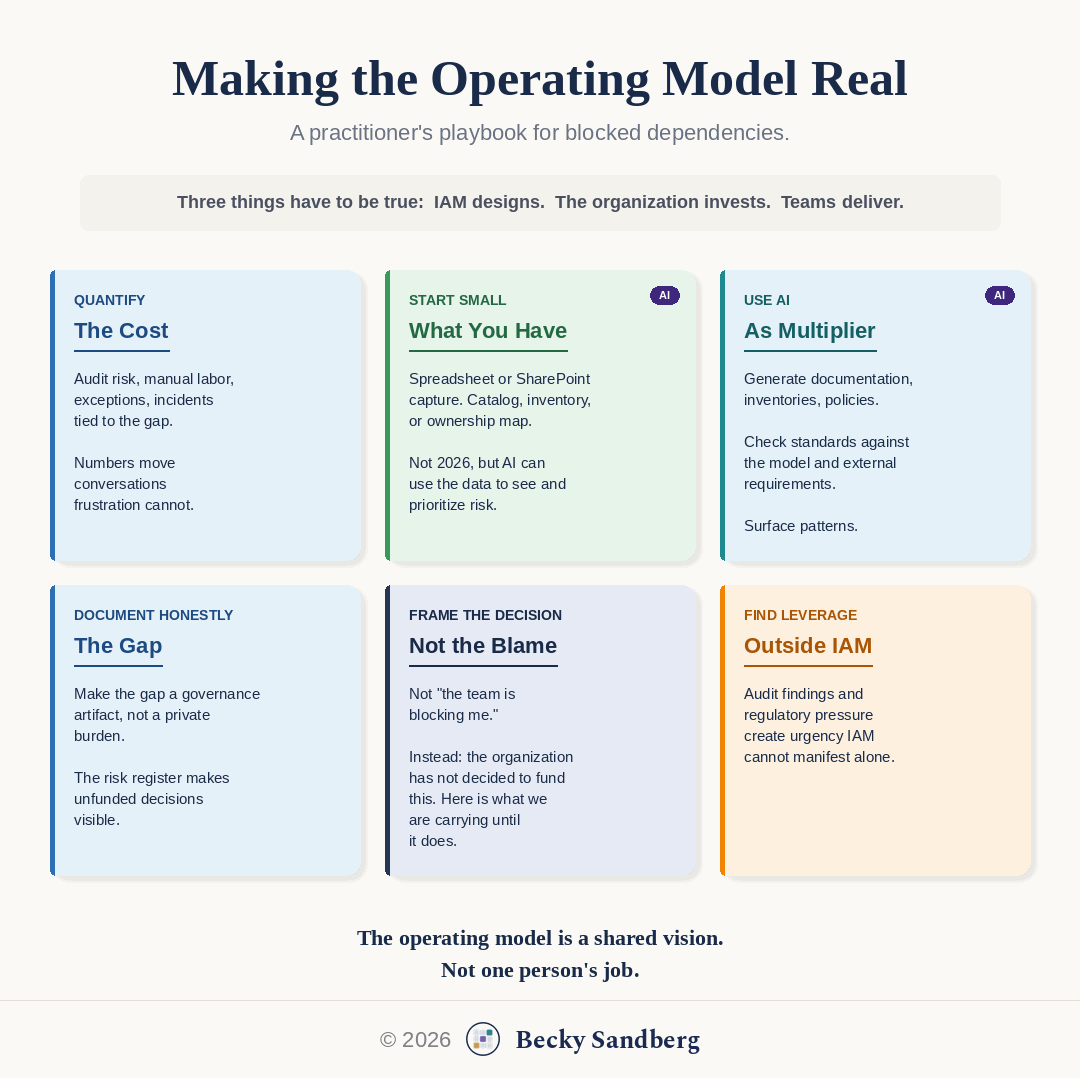
Make progress with these moves:
Quantify what the blocked dependency costs. Audit risk, manual labor, exceptions, incidents tied to the gap. Numbers move conversations frustration cannot.
Start small. A spreadsheet or SharePoint capture is not a 2026 solution, but AI can use the data to see and prioritize risk. The interim proves the value of better tooling that serves multiple teams and governance bodies. Partner with IT for the larger version.
Use AI to compress what humans cannot deliver. Generate documentation and inventories. Check standards against the model and external requirements. Surface patterns. AI shortens the runway when resources cannot.
Document the gap honestly. Make it a governance artifact, not a private burden. The risk register makes unfunded decisions visible.
Frame the gap as a decision the organization has to make. Not "the team is blocking me." Instead: "The organization has not decided to fund this. Here is what we are carrying."
Find leverage outside IAM. Audit findings and regulatory pressure create urgency IAM cannot manifest.
The operating model is a shared vision. Not built by one team. It does not hold without commitment across every dependency. IAM's job is to keep the foundation visible. To keep teaching what is being built, so the vision is shared and funded.
❓ What is one piece of your operating model's foundation that you need the organization to commit to before the rest can hold?
Put it to work. The free toolkit turns ideas like this into templates, a five-minute assessment, and a first move you can finish.
Open the free toolkit